
Wiki
Elna eXpressive 970
Overview
| Name | Elna |
| Location | Textile Area |
| Status | Operational |
| Training | Required |
| Slack Channel | #help-textiles-arts-and-crafts |
| Owner | denhac |
Training
Training is required to be authorized on this machine. The training is split into two parts:
- Machine authorization class (required) — covers safe operation of the embroidery machine itself. This is the class you need to get authorized and start using the machine.
- Software/program class (optional) — covers the design software used to digitize and prep embroidery files. You do not need this class to be authorized on the machine or to use it.
Reach out in the Slack channel to report any issues or suggestions.
Operation
There are two main parts to machine embroidery: digitizing designs and sewing fabric. This guide is intended for the latter. It is recommended to start embroidery with a design that is already digitized, so that you can learn about threads, fabrics, and stitch types.
Safety
- Do not operate the embroidery machine and leave it unattended! You must be present while the machine is in use.
- Do not use the embroidery machine if there is visible or audible damage.
- Turn off the machine when attaching or removing parts like the needle(s), etc.
- Turn off the machine when threading or cleaning the machine.
- Turn off the machine when leaving the machine.
Setup
1. Power off. Make sure the machine is off before threading, changing needles, or touching the bobbin. The power cord plugs in on the left side of the machine; the power button is located above it.
2. Change needles if necessary, using the process in Changing a Needle below.
3. Thread the machine.
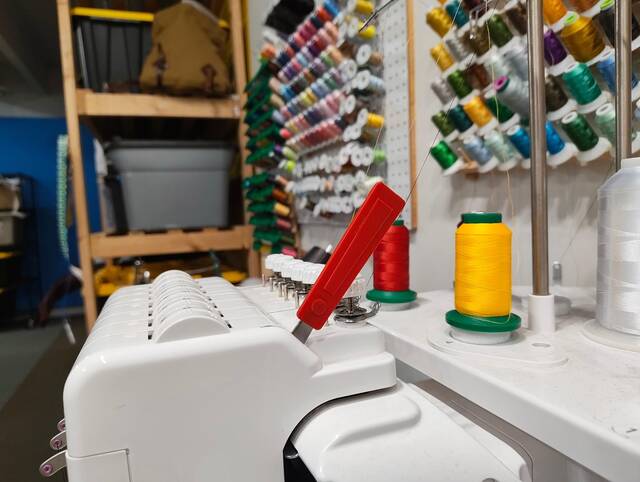
Before replacing needles or the bobbin, push the thread tensioner lever (top right side of the machine) toward the back. This loosens the threads and needs to happen before threading anything.
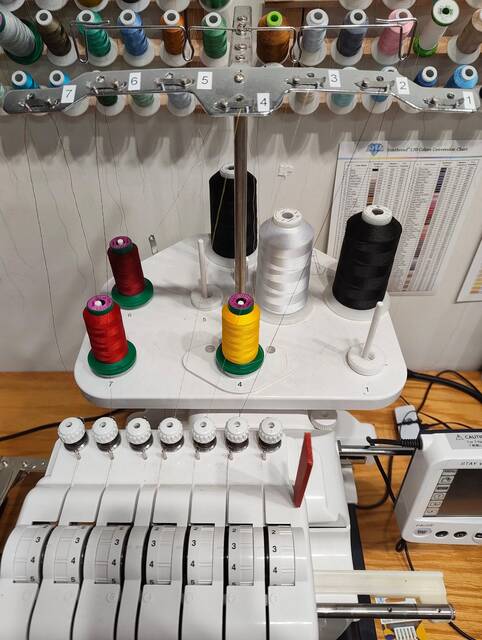
Step A — Get the new thread to the tensioning knob
- Remove the old thread from the needle you’re replacing.
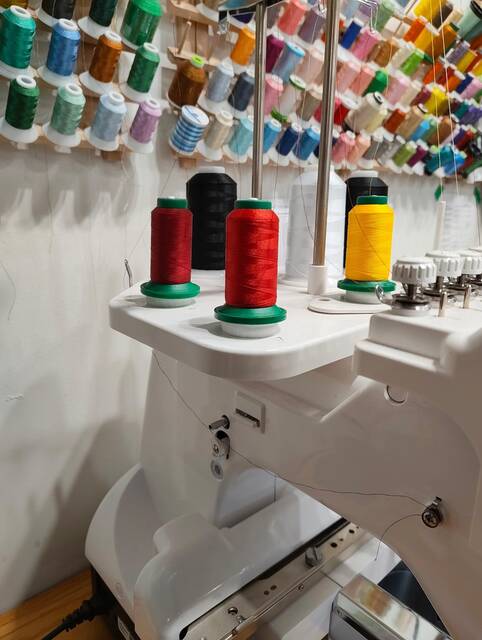
- Place the new spool at the matching numbered position on the thread rack at the top back of the machine.
- Feed the thread through the upper thread holder on the metal arms.
- Continue down to the channel on top of the machine that matches your needle number.
- Thread through the eye hole at the back of the tensioning knob.
- Thread between the tensioning plates — clockwise or counterclockwise, following the arrow printed on the machine for that needle.
Step B — Guide the thread down to the needle
- Down through the smaller of the three guide holes.
- Around the hole that looks like a bobby pin, then back up through the 2nd hole to the take-up arm.
- Back down through the 3rd hole.
- Through the plate hole matching your needle number.
- To the hook on the needle, then through the needle itself, front to back.
Step C — Finish and park the excess thread
- Thread through the presser foot.
- Guide it left, then toward you.
- Leave enough slack to tuck the leftover thread into the small metal spring above the needle — like flossing thread between teeth.
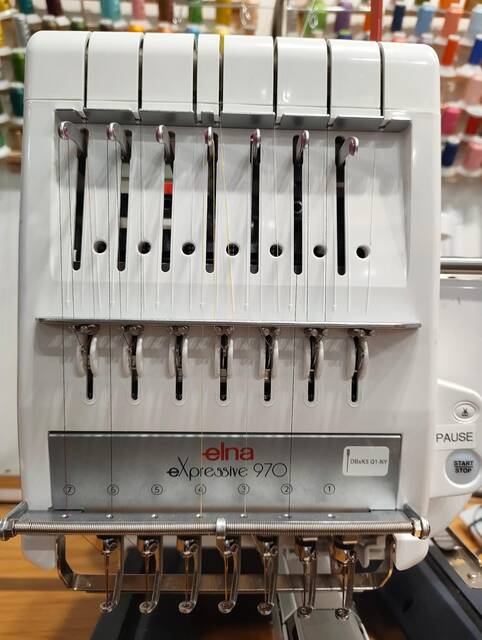
Repeat Steps A–C for every needle you plan to use.
Once you’ve finished threading all your needles, reactivate the tensioning lever (push it back to its normal/forward position) to restore correct thread tension. Skipping this step is a common cause of loose or messy stitching.
4. Insert a bobbin. If there isn’t already a bobbin with thread on it, or you want a different color, you’ll need to wind one.
Fold down the bobbin compartment cover below the embroidery bed to reveal the bobbin case, and remove it by pulling the small metal lever on the case.
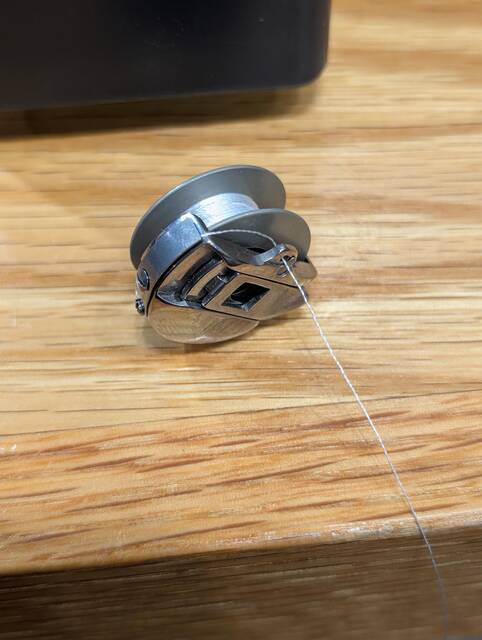
To wind a new bobbin: empty the bobbin, find the bobbin winder spool pin on the left-hand side of the machine, place your thread cone on the holder at the top of the machine, thread it through the metal arm and then the clip on the back-left side, wrap it around the front cylinder and through the empty bobbin, then press the “thread bobbin” button on the control panel — hold the thread lightly so it doesn’t fly loose while it winds. It will spool automatically until full; remove it from the winder and cut the thread.
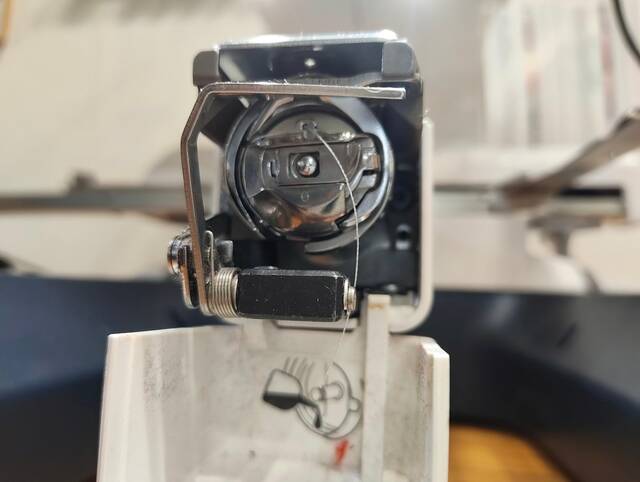
Place the wound bobbin into the bobbin case, thread it per the case’s threading guide, and seat the case back into its home position. Close the bobbin compartment.
5. Select your hoop, interfacing, and fabric.
Select the hoop you’ll be using — leave roughly ½” to 1½” of margin between your design’s edge and the hoop’s edge. Cut your interfacing so it’s about 2 inches larger than the hoop on all sides. If you need to cut fabric for your project, do that next (skip this if embroidering a pre-made item like a shirt or bag).
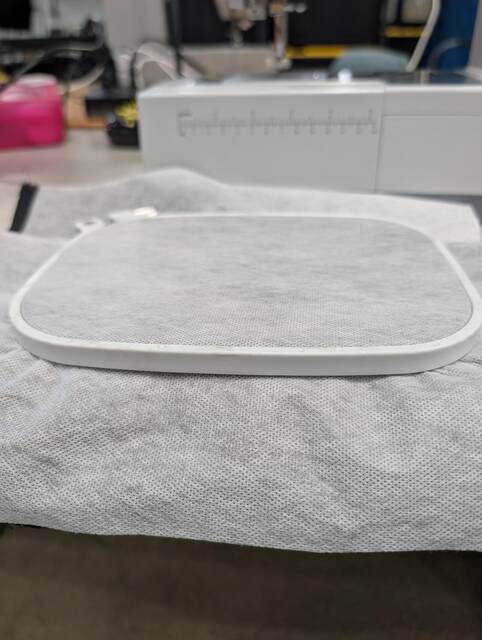
Place the stabilizer over the outer hoop, then set the fabric or item over the stabilizer. Insert the inner hoop (hoop holder), stretch the fabric taut — it should end up drum-tight, like a weak drum — then tighten the screw. You may need to re-tug the edges and re-tighten a couple of times as it bows.
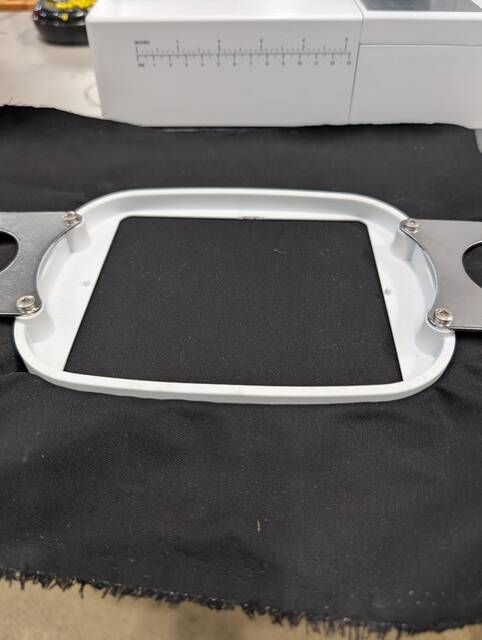
Double-check that the arrow on the hoop, the sticker, and the arrow on the hoop holder all point the same direction. Line up the hoop into the hoop supporter and slide it under the side clips.
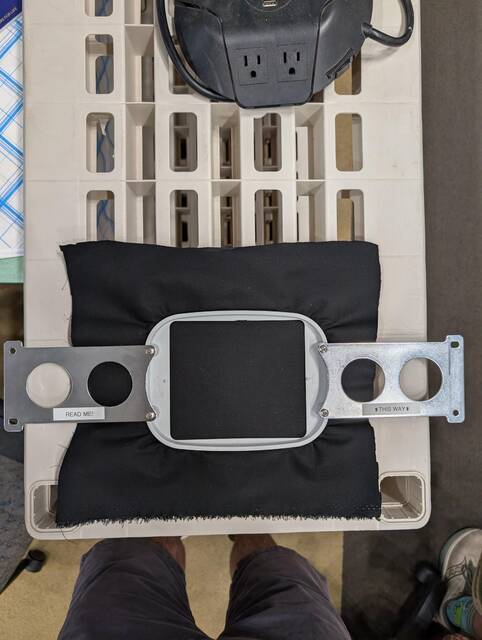
6. Now turn on the machine. Once you’ve threaded it, inserted a bobbin, and put the hoop in place, you’re ready to move to Usage below.
Usage
Save your design file to the USB drive first: create a folder named EMB, with a subfolder inside it named embf, and save your design inside embf.
Designs can be .JEF+, .JEF, or .dst files, and must fit within the machine’s max embroidery area of 9.45″ x 7.87″.
Use the LCD touch panel to find your file on the USB drive, or select a preprogrammed design.
- Tap the file icon (left side) to open file selection, then the arrow near the USB icon to browse the drive.
- Select your design — the screen shows a preview along with its thread/color selections.
- Tap the blue arrow on the right for needle assignment: Auto-assign (1st icon) or Manual assign (2nd icon, typically used here). In manual mode, use the up/down arrows to move between design colors, and the +/− icons to assign each color to a physical needle.
- The machine automatically centers the design in the hoop; you can adjust placement using the grid on the LCD screen (a physical grid sheet can also be placed in the hoop for reference — remove it before starting).
Understanding the control screen (RCS):
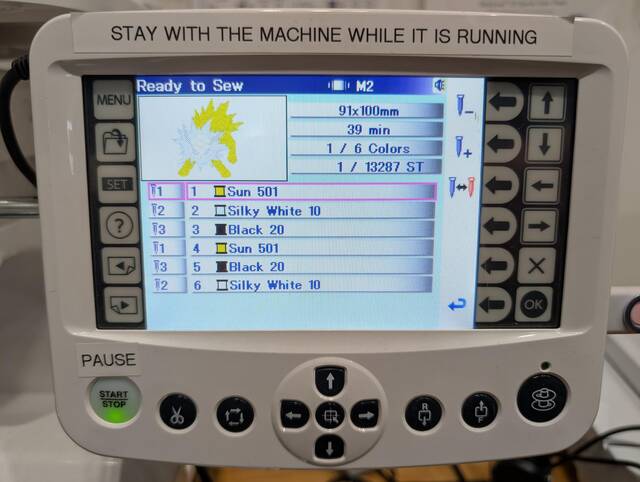
The main “Ready to Sew” screen shows a thumbnail of your design (top-left), design size / estimated time / current color / current stitch count (top-right), and the color-to-needle list (center) — each row pairs a physical needle number with a color in the design’s stitch sequence. The same needle can be reused for multiple colors later in the sequence.
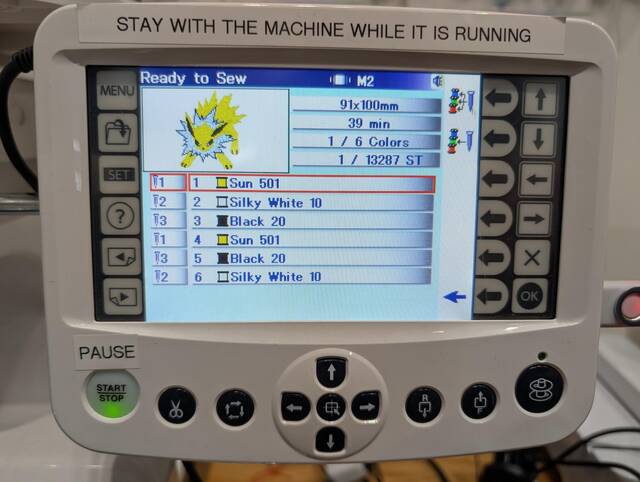
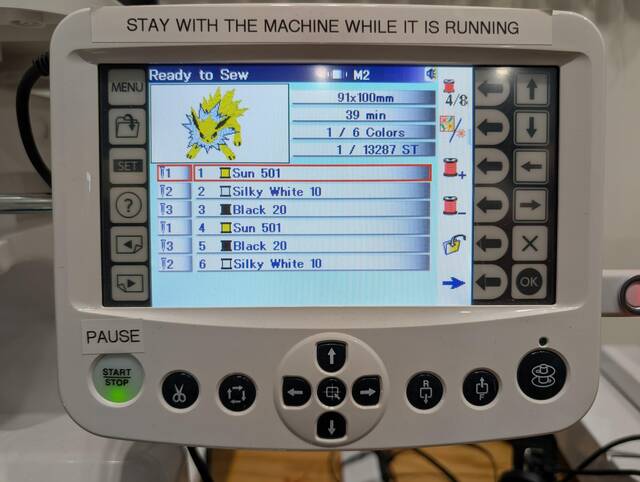
Tapping the blue arrow switches the right-hand icon column into needle-assignment tools — the needle/thread stack icons choose auto- vs. manual-assign mode, and in manual mode, +/− icons step the assigned needle up or down for the highlighted color.
Starting the machine:
Once you press Start, the machine will confirm the hoop size — press Start again if it’s correct.
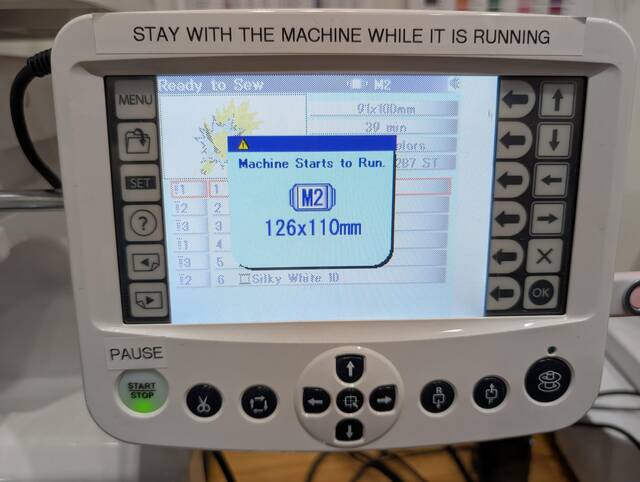
You can use a larger hoop than the machine confirms, but not a smaller one.
The machine will give an estimated run time based on stitch speed — this is an estimate and could take longer. Make sure you can be present for the entire run; incomplete projects can’t be left on the machine. You can change stitch speed on the screen once it’s running (this also updates the estimated time). To pause at any point, press Start/Stop.
If your design uses multiple colors, release each color’s thread from the spring (see the threading step above) before the machine starts using it — otherwise it will break the needle. You can program a pause between colors, or press Start/Stop manually to pause and check.
The machine will stop once it has finished your design.
Monitoring
- Do not leave the machine running and unattended. You must be present while the machine is in use.
- Pay attention to what you and the machine are doing.
- Make sure that the stitches are forming and that everything is running smoothly.
- Release each color’s thread from the spring before the machine starts using it.
- Keep an eye out for needles breaking.
- If the thread looks loose, check that the tensioning lever (red lever, top of machine) is pushed forward/active.
- If the machine makes any weird noises, stop using it and report it in the Slack channel.
- If the machine is not functioning properly, report it in the Slack channel.
Shutdown & Cleanup
- Power off the machine.
- Remove the hoop and your project. Put the hoop back on the machine or in the desk drawer.
- Please discard all thread and any other scraps.
- If there is thread or cuttings on the floor, vacuum them up.
- Empty the trash when it gets full.
Changing a Needle
Tools needed: flat-head screwdriver, new needle (size 11 / 75-11), tweezers.
Power off the machine first (see Safety, above).
- Using the flat-head screwdriver, loosen the set screw just above the needle — it will drop out once loose enough.
- Insert the new needle with the flat side (just above the eye) facing outward, and the eye facing front-to-back.
- Push the needle up as far as it will go, until it stops.
- Retighten the set screw finger-tight — just enough to hold, not overtightened.
Troubleshooting
| Symptom | Cause | Solution |
|---|---|---|
| Loose or messy stitching | Tension lever wasn’t reactivated after threading | Push the red tension lever (top of machine) forward/active before sewing |
| Thread breaking repeatedly on one needle | That needle’s path is threaded incorrectly, or the needle is bent/damaged | Re-thread the needle following the Setup steps above; replace the needle if it’s bent |
| Needle breaks partway through a multi-color design | Thread for the next color wasn’t released from the spring before the machine reached it | Always release each color’s thread from the spring before the machine starts using it (see Usage) |
| Bird-nesting on the underside of the fabric | Bobbin threading or bobbin tension issue | Re-check the bobbin case installation (Setup, step 4) |
| Skipped stitches | Dull or bent needle, or wrong needle type/size for the fabric | Replace the needle; confirm you’re using size 11 (75/11) |
| Puckering fabric | Hoop wasn’t tightened drum-taut enough, or stabilizer is too light for the fabric | Re-hoop with the fabric pulled taut; consider a heavier stabilizer |
Accessories
The Elna has hoops, needles, scissors, bobbins, a bobbin case, lint brush, seam ripper, handy needle threader, spool caps, spool nets, oiler, and tweezers. All of these are stored in the large desk drawer under the machine. The small accessories are kept in a clear plastic box.
Materials
The materials needed for embroidering are fabric, stabilizer, and thread.
- Stabilizer/interfacing: cut about 2 inches larger than your hoop on all sides.
- Fabric: non-stretch fabric is easier to hoop and sew than stretchy fabric.
- Thread: stored on the rack above the embroidery machine.
(Information on available materials and where they can be found, plus any allowed/disallowed external materials, still needs to be filled in here.)
Stabilizer Reference
To be filled out.
| Stabilizer Type | Best For | Location |
|---|---|---|
Helpful Videos
To be filled out — the machine also has 6 built-in help videos on its LCD screen (Winding the Bobbin, Threading the Machine, Threading the Needle, Stretching the Fabric, Attaching the Hoop, Changing Needles); add direct links here if any exist.
| Video | Link | Description |
|---|---|---|
| How to Thread the Elna eXpressive 970 | https://www.youtube.com/watch?v=QELrghThoWc | |
| Machine Cleaning | https://www.youtube.com/watch?v=SS8-8T7rHXA | |
| Winding the Bobbin | ||
| Threading the Machine | ||
| Threading the Needle | ||
| Stretching the Fabric | ||
| Attaching the Hoop | ||
| Changing Needles |
Files & Resources
Specifications
| Name | Elna |
| Manufacturer | Elna |
| Year Released | |
| Model | eXpressive 970 |
| Serial No. | 2K2520167 |
| Software | Preprogrammed and Hatch Embroidery |
| Largest Work Area | 240mm x 200mm (9.4″ x 7.9″) |
| Number of Needles & Type | 7 needles, DB x K5 Q1-NY Size 11 |
History
- Purchased new in March 2024 and arrived April 2024.
- Repaired in March 2026 for 1/4 of the 2026 Textile budget