
Wiki
Fundamentally, sharpening is the practice of grinding, honing, and polishing an edged tool. This article will cover the basics of sharpening at denhac, including the sharpening equipment available in the space, and helpful resources for learning how to sharpen your tools. This article is required reading prior to the tool sharpening authorization class. Refer to the events calendar to locate the next training or post in the #help-woodworking Slack channel to request one.
Sharpening Tools Available at denhac
denhac has three primary sharpening tools available: diamond stones, a Work Sharp WS2000, and a granite surface plate. The set of diamond stones include 240-, 600-, 1200-, 2000-, and 3000-grit plates, which require authorization before usage. The Work Sharp is usable without training, but is not actively maintained. The granite surface plate is restricted to use by tool maintainers only (speak to one of the woodworking SIG leads if you are interested in becoming a tool maintainer, or post in Slack to request supervised time to use the granite plate).
We additionally have an eclipse-style honing guide to be used with chisels and plane blades, and a shop-made protrusion stop for setting your bevel angle with the honing guide.
General Tool Overview
There are several types of sharpening methods that exist. All fundamentally accomplish the same thing. Each method has its pros and cons, and which method is “best” is ultimately up to user preference and technique.
Water Stones

As the name implies, water stones are abrasive stones that use water to lubricate the stone and lift away the swarf. Some water stones require soaking in water prior to use; others require just a splash of water on the surface immediately prior to sharpening. Stones can be artificial or natural. Water stones typically use an aluminum oxide abrasive, and are a naturally softer material that will wear away as they are used. For this reason, water stones require regular flattening (typically with a separate diamond stone) for optimal function. The wearing of the stone is a benefit for quick sharpening, since as the abrasives are worn down and broken free they expose fresh cutting material. Water stones are also known as whetstones. Grading for water stones is typically qualitative (e.g., coarse, medium, fine, etc.).
Pros:
- fast material removal
- water is a readily available lubricant
Cons:
- require regular flattening
- water gets messy
- cost prohibitive for a full set of stones
- Actual grit will vary between manufacturers
Oil Stones

Oil stones are very similar to water stones in form and function. Oil stones use oil to lubricate the stone and lift away the swarf, and can be natural or artificial. Natural oil stones are commonly called “Arkansas Stones” after their location of origin, and are just a rock (novaculite) which is graded for sharpening based on its natural characteristics. Artificial oil stones are typically made of bonded aluminum oxide or silicon carbide, similar to water stones. Artificial oil stones are typically made with a stronger binder than water stones, which results in them wearing more slowly than water stones. Regardless, oil stones do still require flattening, though less frequently. Since artificial oil stones use a stronger binder, they will cut more slowly than water or diamond stones. Grading for oil stones is typically qualitative (e.g., coarse, medium, fine, etc.).
Pros:
- Artificial options are typically the cheapest of the three types of stones
- Slower wearing means less flattening
Cons:
- Slower wearing means slower cutting
- Oil as a lubricant becomes very messy and harder to clean
- Natural options are typically the most expensive option
- Actual grit will vary between manufacturers
Diamond Stones
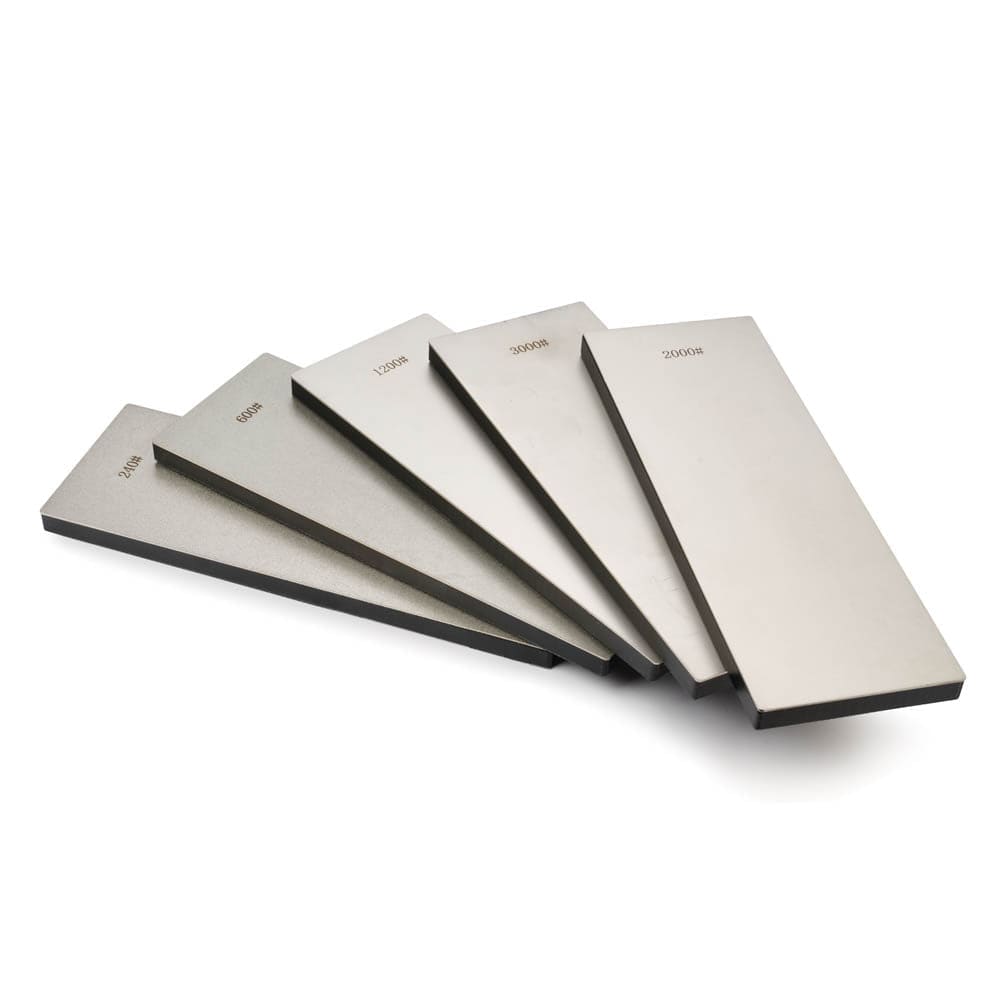
<background>
Pros:
Cons:
Abrasive Papers/Films
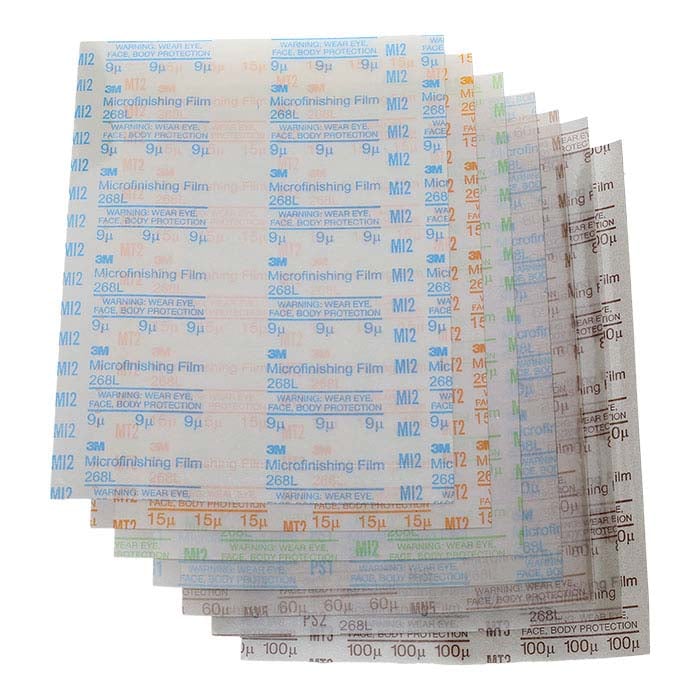
Since sharpening at its most basic is the process of removing metal with an abrasive, one can sharpen a tool using any readily-available sandpaper. There exist many varied kinds of abrasive papers or films which can produce wildly different results depending on their application, and the appropriate paper to be used depends on one’s circumstances. Abrasive papers commonly used in sharpening are made up of aluminum oxide or silicon carbide particles suspended in a resin binding which is adhered to a paper or film backing and a layer of adhesive. The adhesive allows users to stick the piece of sandpaper to a flat reference surface for sharpening. Ideally, the reference surface should be machined flat (i.e., lapped) to ensure a straight and flat edge. Common sharpening surfaces include thick pieces of melamine, float glass, and granite surface plates, amongst others. Abrasive papers use water to lubricate the surface and lift away swarf, however depending on the surface material to which the paper is adhered (e.g., MDF) water may not be the best lubricant option. Grading for abrasive papers is typically quantified (e.g., 220 grit, 40µ, etc.).
Pros:
- Cheap and readily available
- Sheets of abrasive paper can be cut to the appropriate size for a given use case
- easily lubricated with water, oil, or window cleaner
Cons:
- Less resilient than other sharpening methods
- Results depend heavily on the quality of the abrasive paper
CBN Grinding Wheels
Note: training is required before using the bench grinder and is covered in the lathe authorization.
Cubic Boron Nitride (CBN) wheels are industrial grinding wheels used with a bench grinder. CBN wheels are typically made of aluminum or steel that has been coated in CBN abrasive. CBN wheels are typically used for grinding a new bevel on a tool and are generally much coarser than the other sharpening options available.
Pros:
- Very fast material removal
- Does not degrade with normal usage
- Does not require lubrication
Cons:
- Limited materials can be used on the wheels without damaging them
- Can ruin the temper on steels with excess heat build-up
- Individual wheels can be cost-prohibitive
- Limited in the
Slipstones
All of the above sharpening interfaces are for use with straight-bladed tools (e.g., chisels, #1 and #2 sweep gouges, plane blades, etc.). For sharpening curved tools such as #3 and higher sweep gouges, dedicated sharpening tools are often required. For certain curved tools (such as our lathe gouges and carving tools), sharpening can be achieved by moving the tool across the sharpening surface
Strops
For many sharpeners, the final step in sharpening a tool is stropping. Strops come in many different forms, but most commonly are a piece of leather affixed to a flat surface. Often strops will be charged with a stropping compound, which is basically just an abrasive paste that is applied to the strop to aid in polishing. The process for stropping a tool is the same as with the other stones and abrasive papers, however care must be taken to avoid putting too much pressure on the tool as it is being stropped since this can deform the leather and round over the freshly sharpened edge.
Sharpening Techniques
Sharpening at its most basic level takes a tool and an abrasive surface to remove material from the tool to create two smooth, polished faces that meet at a point.
There are two general sharpening techniques: freehand and aided.
Freehand sharpening is exactly what is sounds like. You hold the tool you are intending to sharpen in your hands without any additional interface between the tool and the sharpening medium
Aided sharpening uses some form of jig or guide to serve as a stable interface between the tool and the sharpening medium. Most often, this is accomplished with a honing guide. Honing guides at their most basic hold a tool at a fixed angle and allow for repeated results.
Reference Materials:
Sharpen This (signed by the author + PG-13 Sticker)
(The book is available as a free .PDF, but as an aside, Lost Art Press is a brilliant organization run by some wonderful people so if you are capable of supporting them, please do!)