
Wiki
Overview
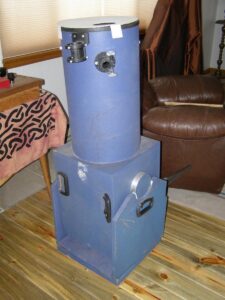
| Name: Coulter 10.1″ Dobsonian Telescope |
| Location: Fishbowl (next to the refrigerator) |
| Status: Operational |
| Training: Read full Wiki |
| Slack Channel: #astronomy |
| Aperture: 10.1 inch f/4.5 focal length: 1150mm |
Training
Read full wiki and reply in #astronomy that you have read the wiki and when you’ll be taking it.
Operation
The Telescope is available for use, you can take it to a darker area for a night or weekend. Just take care of it and tell #astronomy when you take it.
Safety
Never point the telescope at the Sun.
- Never look at the sun with this telescope.
- Do not leave in a place where the sun can pass over it.
Guidelines
- Use care when handling the telescope.
- Never touch the optics
- Keep the telescope from getting dirty. Never store the telescope in the wood shop or anywhere with dust. try not to use the telescope in places with lots of dust like a gravel road. do not point the telescope into a strong wind. Keep smoke away from telescope, keep it far away from campfires, and don’t smoke near the telescope.
- Similarly care for the accessories. When not in use keep all caps and covers on. When in use all dust covers / lens caps / cases should be kept stowed away from dust (in a car / tent not on the ground or somewhere dirty). when changing eyepieces take care and do any adjustments over the case so that if dropped it will not drop on the ground or dust
- Do not try to clean the optics. do not wipe off the optics with a shirt sleeve or even micro fiber cloths. dust on the mirrors / eyepiece will act as sandpaper and scrape the mirrored surface or optical coating on the lenses. you almost never have to clean the optics. Dust will not block much light but even a small scratch will ruin the mirror or optical coating. the mirrors on telescopes have the reflective surface on top of the glass (not behind the glass like bathroom and car mirrors) which makes them way more delicate. default to never cleaning the telescope and focus on keeping the telescope from getting dirty in the first place.
- Do not leave telescope out in rain/snow.
- keep the telescope secure. Don’t leave it unattended in front of Den Hac or somewhere.
How to Use
Moving/Loading/Unloading the telescope:
When moving the telescope move the base first then move the main telescope so that you are never setting the telescope down in dust. Example: to take the telescope to Den Hac’s parking lot to view the moon or something take the telescope out of the base and place it somewhere clean in the fish bowl then take the base outside set it where you want to set it up then take the telescope out and place it in the base so the telescope isn’t sitting on the dirty ground outside. when loading the telescope into your car from Den Hac/stargazing first clear a space in your car for it to slide into (place a blanket down to help protect it). take the telescope off the base and place it into your car first then wipe off the bottom of the base before putting it in your car. to unload take base out first so you can put the telescope in and not have to stage it on the ground.
Calibrating:
before you start stargazing yow will want to calibrate the spotter scope. First put the highest number eyepiece (40mm currently is the most) in the telescope and focus it. Then find something in the telescope that is bright and easily identifiable like a far mountain top or the Moon (never point it at the Sun). once you have it lined up in the main telescope adjust the three knobs that are around the little spotter telescope that is piggybacking on it till the cross hairs are on what you are looking at in the main telescope. Verify the center of the field of view in the main telescope lines up with what is in the cross hairs of the spotter. you can repeat this with a more zoomed eyepiece if more calibration is wanted
Zoom:
Zoom is done by switching eyepieces and it is ruffly focal length divided by eyepiece. Therefore the smaller eyepiece gives you more zoom. Example: 1150mm focal length / 40mm eyepiece = 29x zoom, 1150mm focal length / 12mm eyepiece = 98x zoom. start with lower zoom (higher number eyepiece) as that’s easier to use something like 25mm is usually perfect. you can then zoom in once you found something you want a closer look at. You are limited by how bright what you are looking at is, the Moon can take a lot of zoom a galaxy won’t. think of it like a projector, a home projector takes a lot less light than a IMAX, if you zoom on something dim you will get a bad picture.
Viewing:
First thing I recommend anyone do is just point the telescope at random places in the night sky you’ll be amazed there is almost nowhere you point the telescope in the sky and don’t see stars (unless it’s cloudy). Next find the Milky Way, if it’s dark it should be easy but in the city you might need a phone app to find it and just explore the galaxy. Notice how there’s more stars in the milky way then anywhere else you point the telescope. next challenge yourself to point at a bright planet, star (not the sun), or the Moon. First you get down at the back of the telescope and point it more or less at your target. then look in the spotter scope and put the cross hairs on the target, then look in the main telescope and you should see it (if not try re calibrating instructions above). once you get some bright things use an app or star chart to find deep sky things here’s a list of good first ones: M42 (Orion Nebula), M13 (herculean globular cluster), M31 (Andromeda galaxy), the Seven Sisters, Mizar.
Troubleshooting
| Symptom | Cause | Solution |
|---|---|---|
| not focusing | poor optical alignment | first try each eye sometimes one will be better than the other. close the eye you’re not using (keep the other open) adjust the focus knob next to the eyepiece, try with and without glasses, move your eye towards and away from the eyepiece, remember to breathe (eyes require lots of O2 to work). if it is still not aligned you will need to collimate it here is a good you tube on how to do it: https://youtu.be/8G98RTP6jbY?si=uHO9TErD_PsSIYLa to do this without a laser you can remove the eyepiece and look into the eyepiece hole adjust till the pupil of your eye in in the middle of the mirrors. |
| dark | lens cap is on or cloud | remove all caps, verify where you are pointing it |
Accessories
40mm, 25mm, 12mm eye pieces, spotter scope, lens caps.
Files & Resources
- Check the weather: https://www.weather.gov/
- find somewhere dark: https://www.lightpollutionmap.info/#zoom=6.59&lat=39.6232&lon=-104.9049&state=eyJiYXNlbWFwIjoiTGF5ZXJCaW5nUm9hZCIsIm92ZXJsYXkiOiJ2aWlyc18yMDI0Iiwib3ZlcmxheWNvbG9yIjpmYWxzZSwib3ZlcmxheW9wYWNpdHkiOiI2MCIsImZlYXR1cmVzb3BhY2l0eSI6Ijg1In0=
- How to use a dob: https://www.youtube.com/watch?v=k9xYtpcK0Hc
- How to collimate: https://youtu.be/8G98RTP6jbY?si=uHO9TErD_PsSIYLa
- Do not clean butttt… if you have to: https://www.youtube.com/watch?v=TGALw29wsa8
History
- Refurbished by apfeaver on cloudy nights: https://www.cloudynights.com/forums/topic/534509-coulter-blue-to-terra/ (is local and can be contacted for big repairs / problems)
- Purchased by AstroTours.org
- Given to DenHac Mar 2026